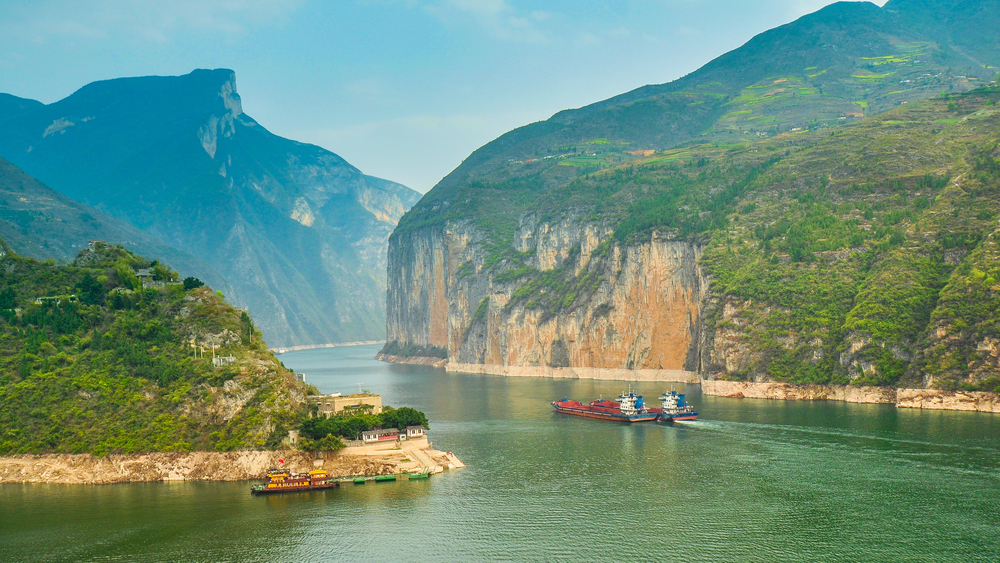
The Yangtze River, a river in the Pacific watershed within China, originates from Geladandong Snow Mountain, the main peak of the Tanggula Mountains in southwestern Qinghai Province on the Qinghai-Tibet Plateau. It flows eastward in a winding course, and its main stream passes successively through 11 provinces, autonomous regions, and municipalities including Qinghai, Sichuan, Tibet, Yunnan, Chongqing, Hubei, Hunan, Jiangxi, Anhui, Jiangsu, and Shanghai, finally emptying into the East China Sea. It has a total length of 6,363 kilometers.
Yangtze River is the longest river in Asia and the third longest in the world.
It is a natural dividing line of North and South China.
The drainage basin of Yangtze River takes 1/5 of China’s land area.
Yangtze River Delta is the most prosperous and populous area in China.
There is the world’s largest hydropower station, Three Gorges Dam, on the Yangtze.
Yangtze River has great influence on Chinese culture since ancient times.
Why the Yangtze Dominates China’s Economy
No other river in China comes close to the Yangtze’s economic footprint. The basin stretching across its middle and lower reaches contains some of the country’s largest cities, including Shanghai, Wuhan, Chongqing, and Nanjing. Together, the provinces and municipalities along the river account for 40% of national economic output, a share that has grown steadily as China’s industrial and service sectors expanded inland from the coast.
The river itself functions as a massive transportation highway. Ports along the Yangtze’s main channel handled 4.2 billion tonnes of cargo in recent years, a 71% increase over the past decade. That makes it the busiest inland waterway on Earth, carrying more freight than any river system in Europe or North America. Bulk commodities like coal, steel, grain, and building materials move up and down the Yangtze on barges that connect interior provinces to Shanghai’s global shipping lanes.